Exercise & Rehab Therapy
Exercise & Rehab Therapy in Science City, Ahmedabad
It is not a sheet of exercises. It is a prescription — and there is a significant difference.
Most people have experienced generic exercise therapy — a printed sheet of five exercises handed over at the end of a session, the same sheet given to most patients with the same complaint. It is the most common reason patients lose confidence in physiotherapy. The exercises feel irrelevant, the progression is unclear, and within two weeks the sheet is forgotten.
Exercise therapy at MoveSync works on a different principle: exercise prescription. Five patients with lower back pain will have five different assessments, five different movement deficits, and five different exercise plans — because their bodies, their histories, their loads, and their goals are different. What they have in common is the diagnosis label, not the treatment.
The other principle that shapes every exercise plan at MoveSync: you do not need to be pain-free to start. In most cases, the right exercise — at the right load, at the right stage — is what makes you pain-free. Starting early, loading correctly, and progressing deliberately is what separates patients who recover fully from those who manage symptoms indefinitely.
What It Does for You

Freedom from pain
Not by avoiding the movement that hurts, but by finding the load and range where movement is possible and building from there. Most patients are surprised to discover that the right exercise, at the right dose, produces more pain relief than rest ever did.
Capacity that lasts
Strength, endurance, stability, and neuromuscular control do not return automatically when pain settles. They need to be trained specifically, progressively, and against the actual demands of your daily life, your sport, or your goals. A body that has been through injury needs to be built back stronger than before — not just returned to baseline.
Independence
The goal of every exercise programme at MoveSync is that you leave knowing exactly what to do, why you are doing it, and how to progress it yourself. You should not need to return to the clinic indefinitely to maintain your results. The programme ends when you are capable and confident — not when the sessions run out.
What Exercise Rehab at MoveSync Involves
Exercise Prescription — Not Protocol
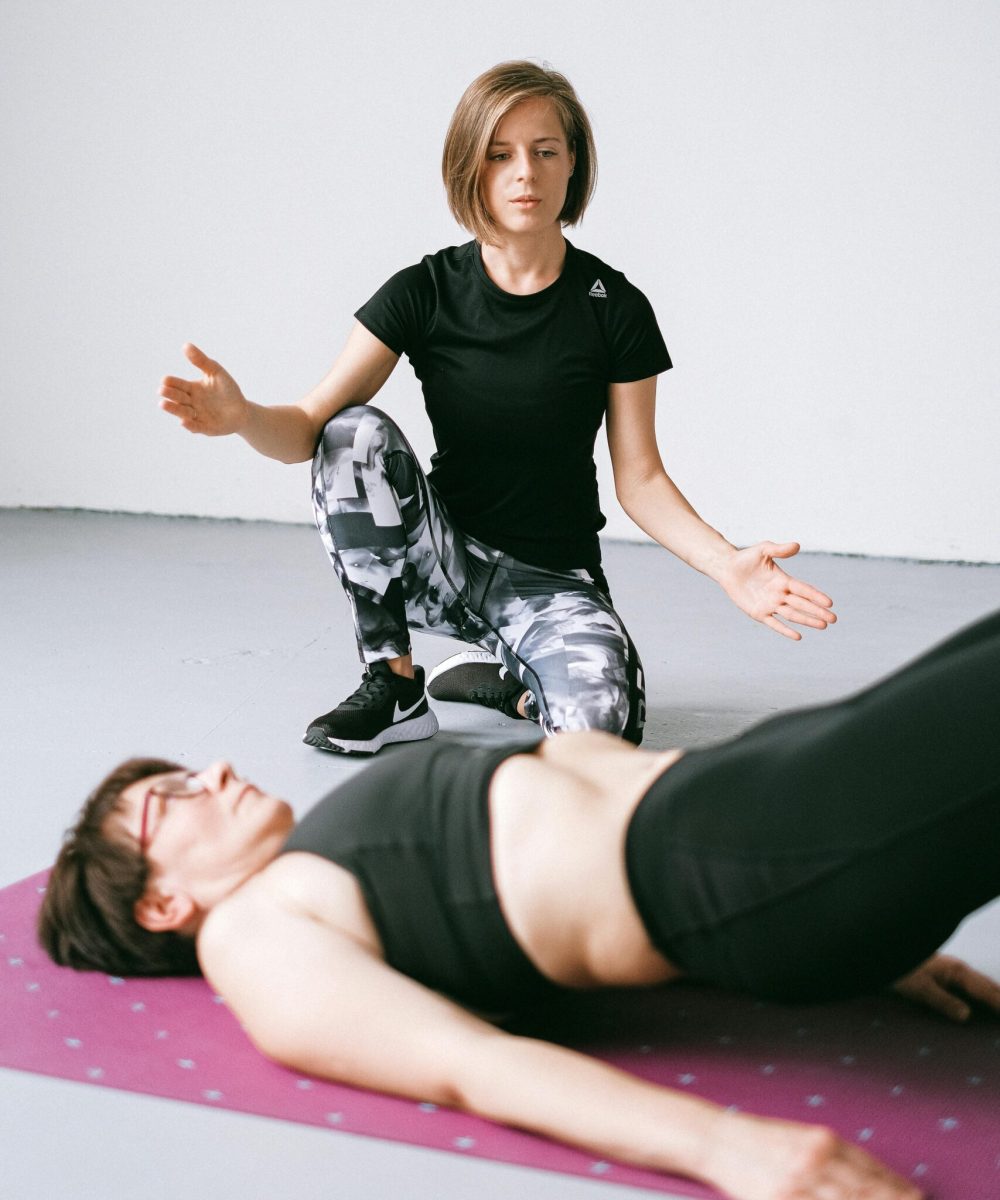
Every exercise plan begins with an assessment of your movement deficits, your strength, your load tolerance, and your goals. The exercises chosen, the load applied, the range used, and the progression schedule are all determined by what that assessment shows — not by a standard protocol for your diagnosis.
Two patients with the same shoulder pain may receive entirely different exercise plans — because one has a rotator cuff activation deficit and the other has a scapular control problem driving impingement. Prescribing the same rotator cuff exercises to both would help one and do nothing for the other. The prescription matches the finding — not the label.
Pressure Biofeedback for Deep Muscle Reactivation

For conditions where deep stabilising muscles — the deep cervical flexors, the transverse abdominis, the pelvic floor — have been inhibited by pain or surgery, pressure biofeedback provides real-time objective data on whether these muscles are actually activating. Not whether the patient thinks they are activating. Whether they are.
This is used routinely for neck pain rehabilitation, post-pregnancy core reactivation, and lower back stabilisation programmes — replacing guesswork with measurable clinical data at every stage of the programme.
Progressive Loading with In-Clinic Equipment
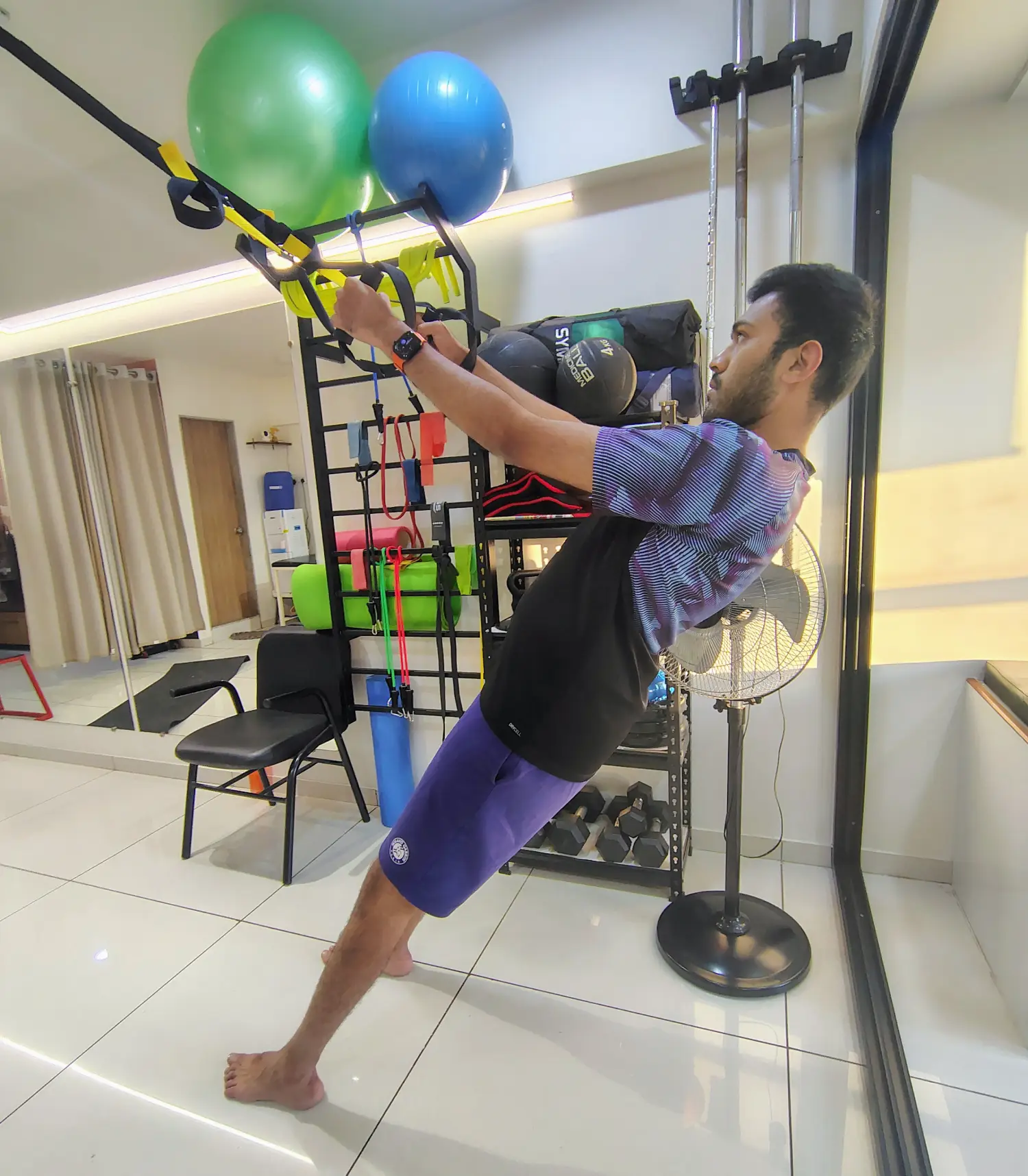
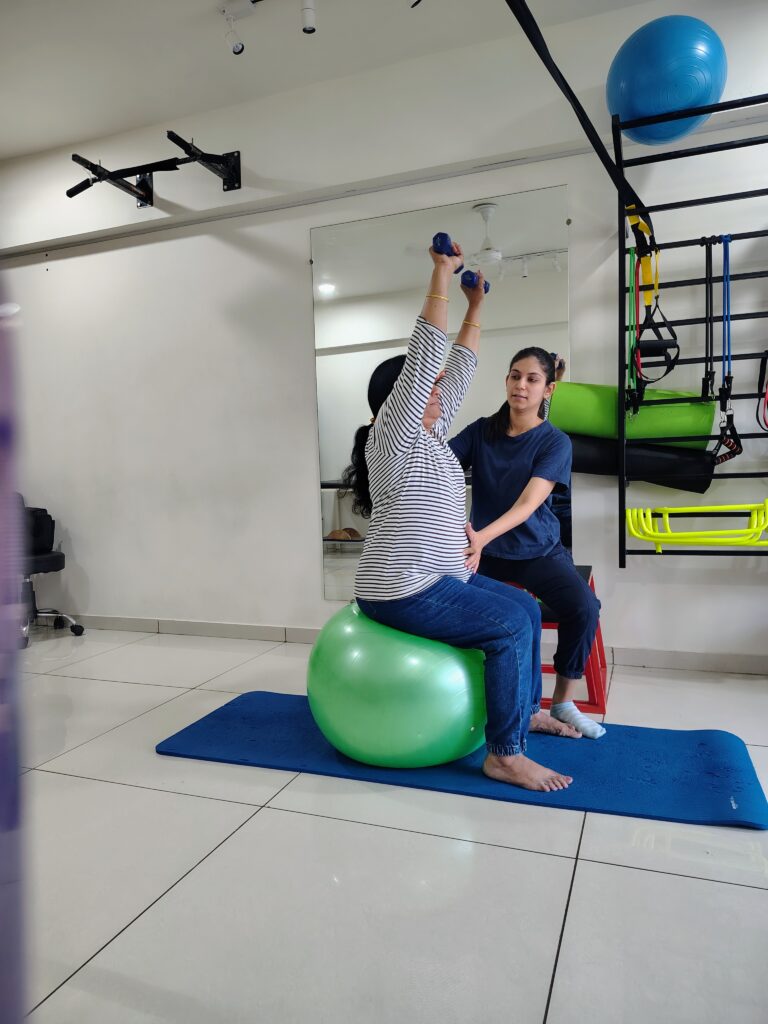
Exercise rehab at MoveSync uses the full range of in-clinic equipment:
Resistance & Load
- Dumbbells
- Kettlebells
- Resistance Bands
- Medicine Balls
Suspension & Instability
- TRX Suspension Trainers
- BOSU Ball
- Gym Ball
Balance & Proprioception
- Balance Boards
- Wobble Cushions
Recovery
- Foam Rollers
- Hyperice Pro 2 Percussion Device
Exercises are progressed in load, complexity, and demand as your capacity improves — not kept at the same level until the next appointment. The progression is deliberate and documented — so both you and your physiotherapist can see exactly where you are and what comes next.
Percussion Therapy and Recovery Modalities
For athletes and active patients managing high training loads, recovery is as important as the exercise itself. At MoveSync, percussion therapy using the Hyperice Pro 2 is used alongside foam rolling, stretching, and mobility work as part of a structured recovery protocol — reducing muscle soreness, improving tissue quality, and maintaining the movement capacity that allows training to continue without cumulative overload.
This is not passive treatment. It is active recovery — teaching patients the tools and techniques to manage their own tissue health between sessions and long-term.

The Get Gym Ready Programme
Many patients reach the end of their pain rehabilitation and face the same question:
“I’m not in pain anymore — but how do I get back to the gym, yoga, running, or sport safely?”
And beneath that question, often unspoken:
“What if I push too far and undo everything? How will I know when I’ve gone too far? Will I be able to trust my body again?”
This fear — called kinesiophobia, or fear of movement — is one of the most common and least addressed barriers in rehabilitation. It is not weakness. It is a rational response to having experienced pain with activity before. But if it is not addressed, it keeps patients stuck in a cautious half-return that never fully restores their confidence or their capacity.
The Get Gym Ready programme at MoveSync bridges the gap between rehabilitation and full return to activity — addressing both the physical readiness and the psychological confidence needed to move without fear.
It is designed for:
- Patients finishing a rehab programme who want structured, confident guidance back to gym training
- People returning to activity after a long break due to injury, surgery, or inactivity
- Adults who want to return to yoga, walking, running, or recreational sport — and trust their body to handle it
- Anyone who wants to sit on the floor, carry groceries, play with their children, or move through daily life without hesitation or the constant background worry of “am I going to hurt myself again”
The programme is built around your specific end goal — not a generic return-to-exercise template. If your goal is returning to deadlifts, the programme works toward deadlift mechanics — gradually, with objective load benchmarks at each stage so you know exactly where you stand. If your goal is walking 5km without knee pain, the programme builds the capacity for exactly that. If your goal is sitting cross-legged on the floor without stiffness, that is the benchmark we train toward.
You will not be told “you can do this now” based on time or pain levels alone. You will be shown — through objective testing and progressively increasing real-world loads — that your body is genuinely ready. That is what replaces fear with confidence.
And for the question that most patients think but rarely ask — “what if I push too far when I’m back at the gym alone?” — that is exactly why the programme does not end with a clearance. It ends with you understanding your own body’s signals well enough to know the difference between productive discomfort and a warning sign. When to push. When to back off. When to call us. That knowledge — built session by session through guided progressive loading — is what makes the difference between a patient who returns to full activity confidently and one who always holds back just in case.
The Cost of Skipping This Stage
Most re-injuries do not happen because patients pushed too hard in a supervised programme. They happen because the pain settled, the patient felt ready, and they returned to activity alone — without knowing whether the tissue was actually prepared for what they were asking of it.
Pain is the last signal to appear when a structure is being overloaded — and the first to disappear when it settles. By the time you feel it again, the damage is already underway. The patients who end up back in our clinic — or in a surgeon’s office — after a recovery are almost never the ones who progressed too aggressively under guidance. They are the ones who felt good, stopped coming, and quietly overloaded a structure that was not yet ready.
Everything you worked for in rehabilitation — every session, every uncomfortable exercise, every week of patience — can be undone in one poorly managed return to training. The Get Gym Ready programme exists because that outcome is entirely preventable. And because no YouTube programme, no gym trainer, and no generic return-to-exercise plan can tell you what your specific body is ready for right now.
What to Expect
Your first exercise session
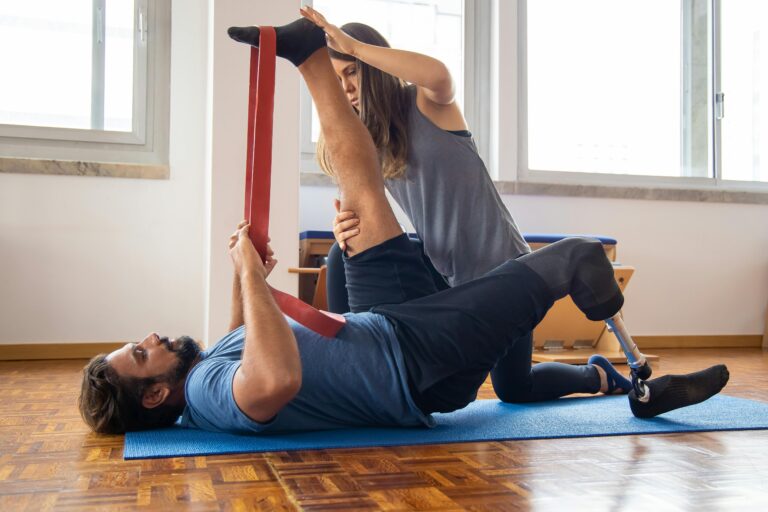
After your initial assessment, your physiotherapist will explain the clinical reasoning behind every exercise selected — what it targets, why it is appropriate for your presentation, and what you should feel during it. You will not be given exercises you do not understand.
Progression
Exercise plans at MoveSync are reviewed and progressed at every session. If an exercise is too easy, it is made harder. If it is producing the wrong response, it is modified. The plan evolves with you — it does not stay static between sessions.
Home programme
A home programme is introduced progressively — not handed over at the first session as a substitute for in-clinic work. In early sessions, the focus is on learning correct movement under supervision. As your form and understanding develop, a structured independent programme is built alongside your in-clinic work — so that by the time you are ready to manage independently, you have the knowledge and confidence to do so correctly.
You Feel the Results in the Same Session
Every exercise intervention at MoveSync is tested immediately. You perform the movement before and after the exercise — so you can feel the change in your own body before you leave the clinic. Not described to you. Not promised for next week. Felt now. That is what builds the trust in the process that makes the home programme work.
At MoveSync Specifically
Exercise therapy at MoveSync is led by the same clinical philosophy that runs through every other treatment approach: find the root cause, address it specifically, and build capacity that lasts. Generic exercise sheets are not used. Every plan is prescribed, progressed, and adapted to the individual.
For many patients, structured progressive exercise rehab is the difference between surgery and not needing it. Tendons heal under load. Joints stabilise through progressive resistance. Discs centralise with the right movement pattern. Surgery addresses structure — exercise addresses function. In many cases, function is what was missing. Multiple patients who were advised to consider surgery have returned to full activity through exercise-led rehabilitation at MoveSync — without an operation.
The combination of in-clinic equipment, pressure biofeedback, percussion therapy, and the Get Gym Ready programme means that exercise rehab at MoveSync covers the full spectrum — from the first pain-free movement after an acute injury to returning to competitive sport or a demanding fitness routine.
MoveSync has supported athletes through Guinness World Record attempts, Ironman 70.3 completions, Masters Athletics nationals, and Everest Base Camp expeditions. The same clinical standard — thorough assessment, precise exercise prescription, progressive loading, and objective clearance — applies to every patient, regardless of whether your goal is a world record or walking to the corner shop without pain. The level of care does not change based on the ambition of the goal. It changes based on what your body specifically needs.
Conditions Where Exercise & Rehab Therapy Is Used
Exercise therapy is a component of treatment for every condition we see at MoveSync. Key applications include:
Frequently Asked Questions
Do I need to be pain-free before I start exercise rehab?
How is this different from the exercises my previous physio gave me?
What is the Get Gym Ready programme and who is it for?
Take the Next Step
If you want exercise therapy that is built around your body and your goals — not a generic sheet — an assessment is the right starting point.